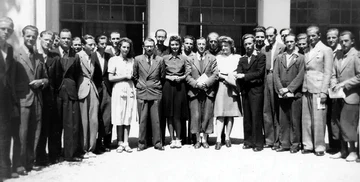
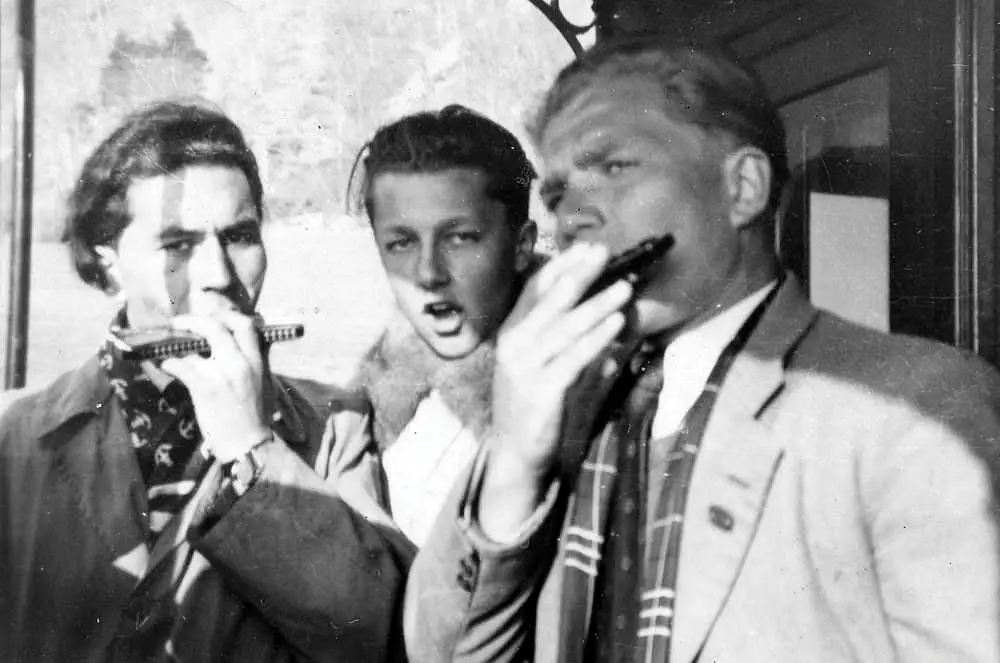
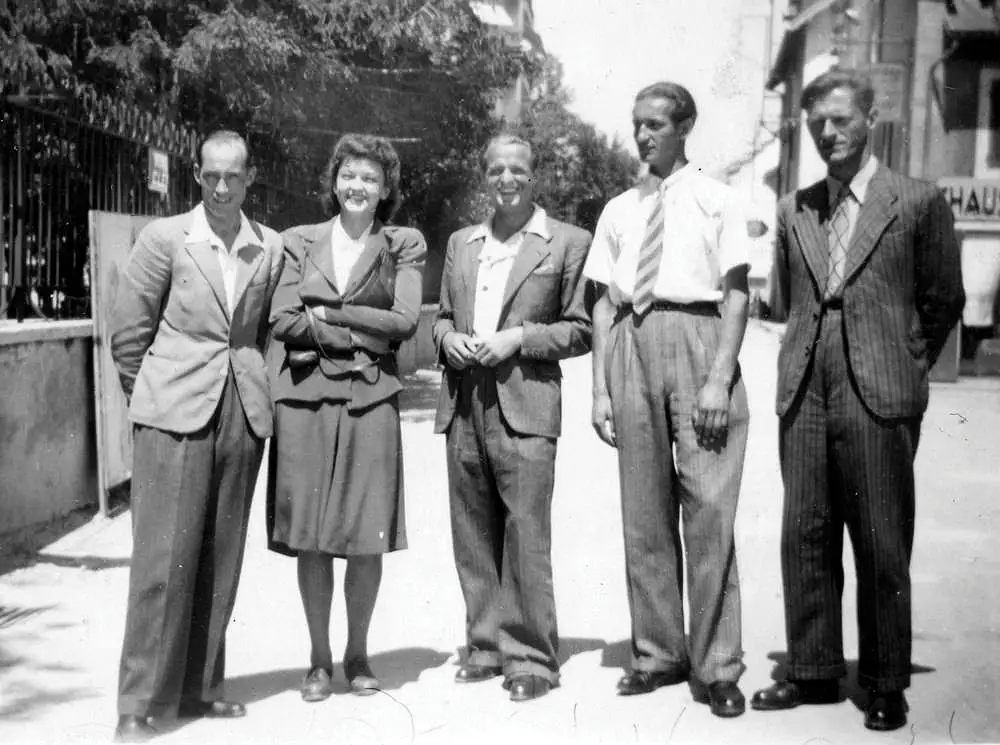
The total number of people who worked or studied at the school can be estimated at nearly eight hundred. To produce statistics for a such a varied sample is almost impossible and, in many respects, would be pointless. That said, two things are certain: the community was extremely diverse in terms of social and geographical origin, and extremely young in terms of both marital status and state of mind – which, while not a statistical category, is nonetheless a tangible and precious reality.
The geographical origin of students, as defined by their place of birth, is a highly significant factor. Unfortunately, the data is incomplete: for 17% of students, their place of birth is missing, incomplete or unclear. However, this means that it is known and certain in 83% of cases, which is a sufficient basis for quantitative analysis. Out of the 574 students, 64% were born in Poland, 33% in France and 3% in other countries.
There is not sufficient data to accurately define the social background of all the students who were born in Poland. We only know that they reflected the whole of pre-war Polish society, from the aristocracy and large landowners to the bourgeoisie, including civil servants, craftsmen, workers, farmers, the liberal professions, teachers and schoolteachers, not forgetting the state’s senior civil and military officials. A significant proportion of the students from working-class or farming families actually belonged to the “old” emigration group, in that, although they were born in Poland, they had left the country at a very young age to accompany their parents to France.
During the six years of its short existence, the school’s demographic situation (taking into account the exceptional circumstances caused by the war) was atypical in terms of the age pyramid and the age gap between students. There was a thirty-year difference between the oldest student, Władysław Wicha (born in 1904) and the youngest, Jacek Maciej Siebeneichen (born in 1934). The former left the grammar school in the summer of 1943, while the latter entered in the autumn of 1945, just two years later.
With regard to the teachers and supervisors, the majority were men (71.2%). It should also be noted that many of the teachers came from Poland’s border territories: two were born in Belarus, two in Ukraine, two in Eastern Galicia, one in Lithuania and one in Zaolzia, a part of Silesia to which both the Czechs and the Poles laid claim.
For the administrative staff, the list includes six women and nine men. It is undoubtedly incomplete, as the staff changed frequently. There was much more stability in Villard than in Lans.
The high school had a medical service, consisting of several doctors and a nurse in Villard, and a doctor in Lans. As France did not recognise Polish medical qualifications, doctors officially bore the title of head nurse. There were also part-time dentists, about whom no information has been preserved. However, it seems that the average age of the medical staff was much higher than that of the teachers.
The list of employees who worked in “physical” occupations is the most incomplete. Places and dates of birth are known in very few cases. It seems that the average age was higher than that of the teachers or the administrative staff.