
3.6.1 “Both demanding and understanding.”
—Adam Skinder, student. Our school, 2017, based on Mój Villard de Lans, 1978.
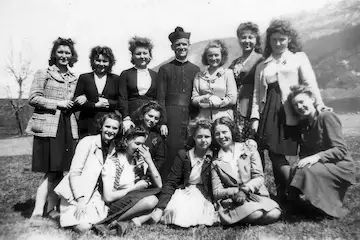
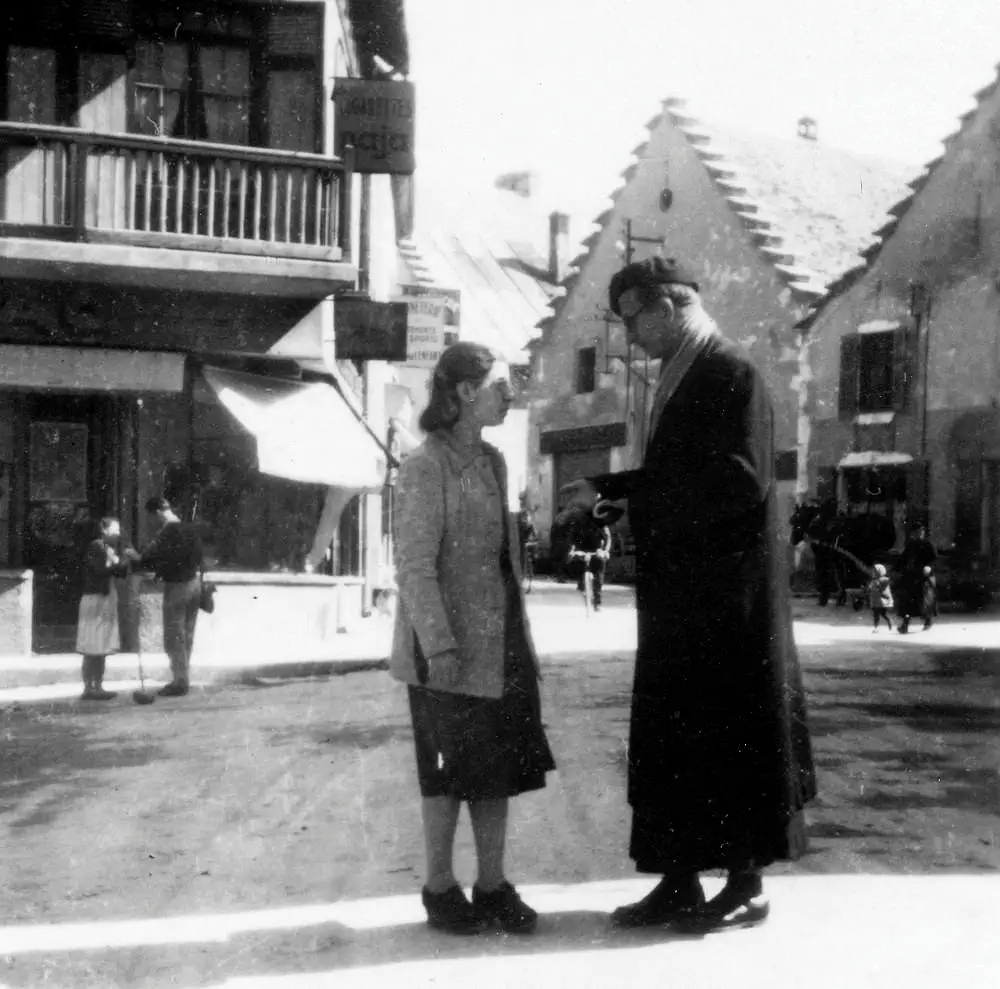
Bronisław Bozowski was tall, energetic, always smiling and ready to joke. He was happy to be in the company of the former soldiers that we were, and was both demanding and understanding towards us. We saw him every day, wearing his big Basque beret and wrapped in his scarf, arriving at the Hôtel du Parc after morning mass or returning to his home in the upper part of the village. He was quickly nicknamed Bozower, and to this day I don ‘t know anyone who didn ‘t call him that, but always with deep respect. He seemed quite happy with the nickname.
Bozower used his morality lessons to pound ethical rules into our heads, insisting on the role of individuals in society, on their duties and responsibilities towards themselves and others. He filled lectures with examples and quotations, and steered the debate towards the conclusion he had predetermined. He kept telling us that man cannot be a mere consumer of goods, that he must be a creator who gives himself entirely to his work in order to bring about the reign of Good on earth. Work, work, and more work: only work ennobles man! “For me, work is a pleasure!” he liked to say, which inevitably led to the counter-argument: “But man cannot live for pleasure alone!”. And that ‘s when the discussion would become more heated!
Bozower honoured anyone in whom he saw a true Pole, a person worthy of the name. So one day our comrade W. W., who later became a Minister in the People ‘s Republic of Poland, told him that as a Communist he was not a believer, but that as a Pole he would fight tirelessly for his country. Bozower acknowledged this: I know you ‘re a patriot and I respect that. We do not have to make distinctions between our convictions as long as they are pure.