9.2.1 A Polish free school in occupied France - Tadeusz Łepkowski
—A historical “bible”.
Tadeusz Łepkowski was admitted to the Polish high school in Villard-de-Lans. He passed his baccalaureate there in 1945 and began studying history at Grenoble University. He returned to Poland in 1946 and continued his studies in Warsaw. From 1953 onwards, and for the rest of his life, he worked at the Institute of History of the Polish Academy of Sciences. A prolific writer, he published around 370 books, essays and articles. In August 1978, an Editorial Committee for the history of the Cyprian Norwid high school in Villard-de-Lans was set up in Warsaw. Tadeusz Łepkowski took on the role of president, was chosen as editor, and began to gather information and documents. The project took more than ten years to acquire concrete form. A questionnaire was circulated, to which around forty alumni responded. Łepkowski very much wanted to return to Villard and Grenoble, to meet alumni and other people involved, and to consult the archives. He had a lot of trouble organising the trip, but finally made it in October 1988. He talked to one of his former teachers at the high school in Villard, his “Dear Mr Malbos” , about the difficulties of the journey and the more general difficulties he was encountering in completing the book. He knew that he did not have the approval of some of his former colleagues, who could not digest the fact that he was once part of the communist nomenklatura. He refused to give in to those who wanted him to write a hagiography. “Believe me, I ‘m doing everything I can to finish the history of the school. Non-historian colleagues – understandably – want to have the text as quickly as possible (a kind of memoir written with tears in their eyes: everything was excellent, etc.). I cannot write that way. It must be a scientific work, a work written not to weep for posterity, but to tell the truth, which is almost always complex.”
All that remained was to find funds to publish the book. The alumni were contributing, as was the Polonia association. Łepkowski returned to France in July 1989, to Paris, invited to celebrate the bicentenary of the French Revolution. The history of the school was almost complete. The text was sent to the printer in September. Poland was undergoing extraordinary changes. Łepkowski was overworked and also chaired the Solidarność Commission of the Academy of Sciences. He died suddenly on 16 December 1989. His book was published a few weeks later.
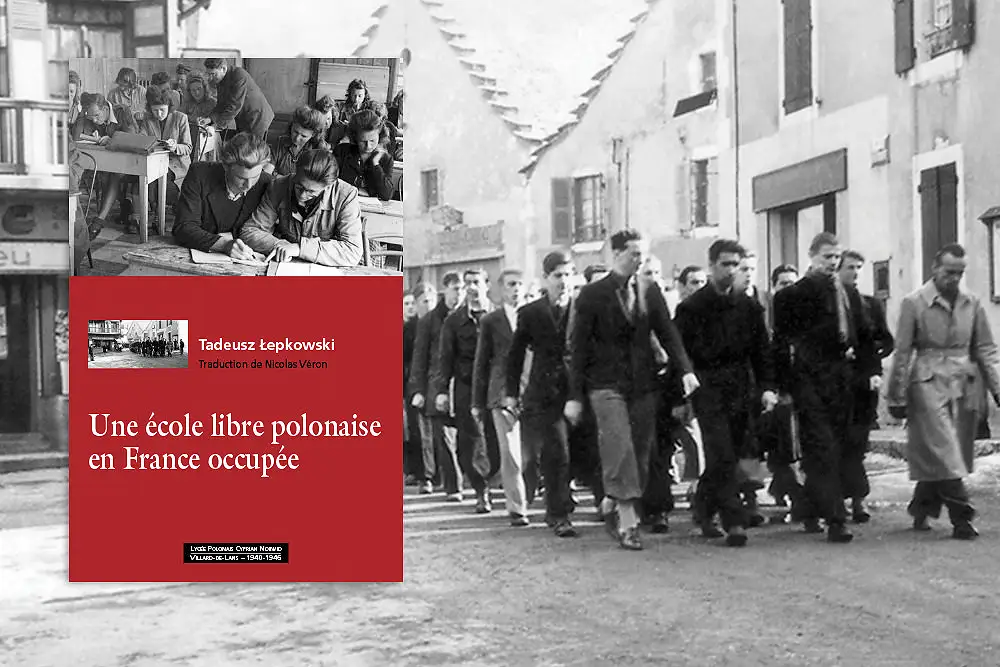
As soon as Tadeusz Łepkowski ‘s book appeared in Poland, the issue of translating it into French was raised and publishing what most of the alumni considered to be the most comprehensive text on the history of their school, their “bible” . It was a huge project that would require both human and financial resources. This dream did not become a reality until 2007, when a new team at the head of the alumni association found the energy and funds to move forward. However, that was just the beginning: it took five years for the work to be completed. Thanks are due to the translator, Nicolas Véron, who managed to make the sometimes rather heavy Polish more fluid in French!
The team sent the French manuscript to around ten former students and asked for their comments. A few marginal errors were reported and corrected. There were some bitter comments, reproaching Tadeusz Łepkowski for his partiality: even today, tensions remain between those who returned home and “compromised” with the leaders of “popular” Poland, and those who chose to prioritize their political and patriotic convictions. There were also complimentary comments: Łepkowski’s book remains the reference work on the Polish high school, the only one written by a historian.
Published by the association, it contains 370 pages and numerous footnotes.
It is available from the association and at the Maison du Patrimoine in Villard-de-Lans at a price of 20 euros.
It can be downloaded for free here.