
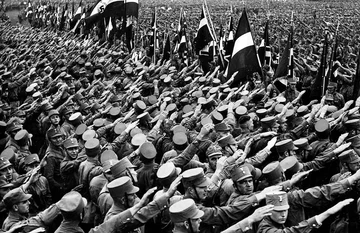
The dark shadow of the swastika
From the moment he took power in 1933, Hitler manoeuvred to enlarge the Lebensraum (“living space”) for the German Aryan “master race”. Treaties and agreements made after the First World War did not prevent the militarization of the Reich and claims to territories that were formerly German or shared a common bloodline and culture such as Rhineland, Austria, and Sudetenland. And soon the demand for free passage through Polish territory to the Free City of Danzig.
When Adolf Hitler entered politics, he adopted the ideology of the Pan-Germanist thinkers. He used the economic crisis of 1929 to come to power and apply the principles of Nazism summed up in the slogan Ein Volk, ein Reich, ein Führer (“One People, One Empire, One Leader”).
”One people” is the Aryan people. The Aryan “race” is superior. To achieve a pure human species, it must eliminate the inferior “races”, first and foremost the Jews, and marginalized communities: homosexuals, gypsies, disabled people, etc.
The empire is the Lebensraum, the living space essential for the Aryan race to flourish. The objective being to form “Greater Germany”, in the image of the Holy Roman Empire and the Germany united around Prussia from 1870 to 1918. The leader is, of course, Hitler.
In his book Mein Kampf (1924), Hitler announced his objectives. First, to eliminate the anti-German measures in the Treaty of Versailles, and to recreate a powerful German army and militarize Germany and the German territories in the Rhine region. Second, to unite all the European peoples of Germanic culture around the German Reich, whether they were willing or not. Finally, to conquer the living space. This conquest would target the Slavs (Poles, Russians and Ukrainians), and also the French.
Recovering the territories withdrawn from Germany at the end of the First World War (West Prussia, etc.) and brought under Polish control was all the more important as many Germans lived in Poland.
Elected Chancellor in 1933, Hitler embarked on his programme under the passive eyes of European governments.