6.2.1 “Educating oneself in order to prepare for the future of the country.”
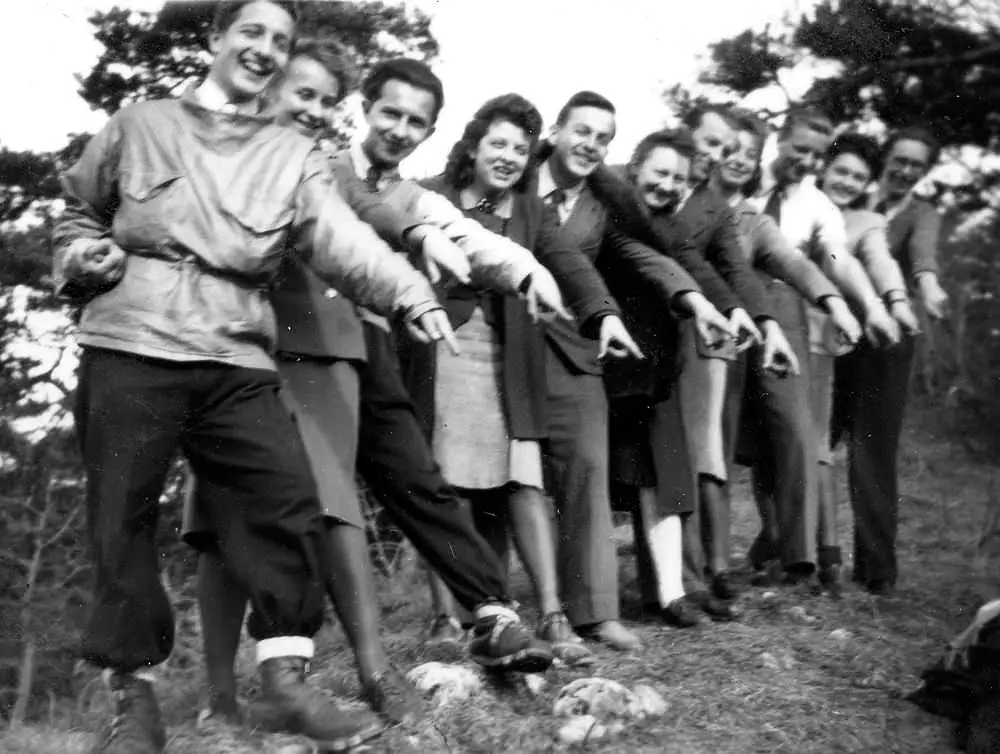

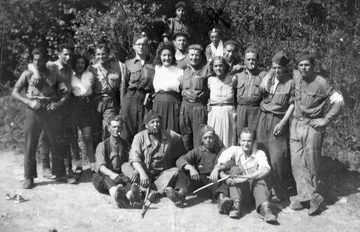
Ludwik Wilk, a carpenter at the high school, was the first to join the Resistance in Vercors in January 1944. You can recognise him, in the middle of the back row, by the white eagle on his beret (Association Mémoire du lycée polonais - Polish High School Memorial Association).
While at the high school or after leaving, young people and adults, boys and girls alike, took part in resistance activities. They joined the French and Polish networks and paid the price: four were killed and around thirty deported, three of whom did not return.
To study was to serve “the homeland, the nation, freedom and the people”, and this way of serving was supposed to last for the duration of the studies: the time for combat was postponed until after Villard in order to preserve the establishment. But how could they not want to act? The various forms of clandestine action were the logical culmination and implementation of the Villard ethos, born of the spirit of patriotic sacrifice that reigned at the school.
Former students stayed in France and joined the French and Polish networks (POWN, F2) and took part in their activities: liaising, organising cells, finding weapons, assisting escapees, crossing borders, etc.
During a lunch at the Hôtel du Parc, Zaleski spoke out. He criticised the haphazard and ill-considered attempts to cross the Spanish border illegally, expressing the opinion, which I have already mentioned, that heroism did not consist in allowing oneself to be caught by Franco, but in “surviving and educating oneself in order to prepare for the future of the country” . Zabiełło thought the same, and wrote after the war: “I personally devoted a great deal of time and attention to this school, inspecting it myself several times a year. During the discussions that took place on these occasions, I tried to explain to the young people that, given the current political and military circumstances and, above all, the extermination of our country ‘s intelligentsia by the occupying forces, our first duty was to make the most of existing opportunities to acquire the education and knowledge required for the colossal tasks that Poland would have to face after the war.” He added that, when the time came, the older generation would give the younger generation the “signal for action” .
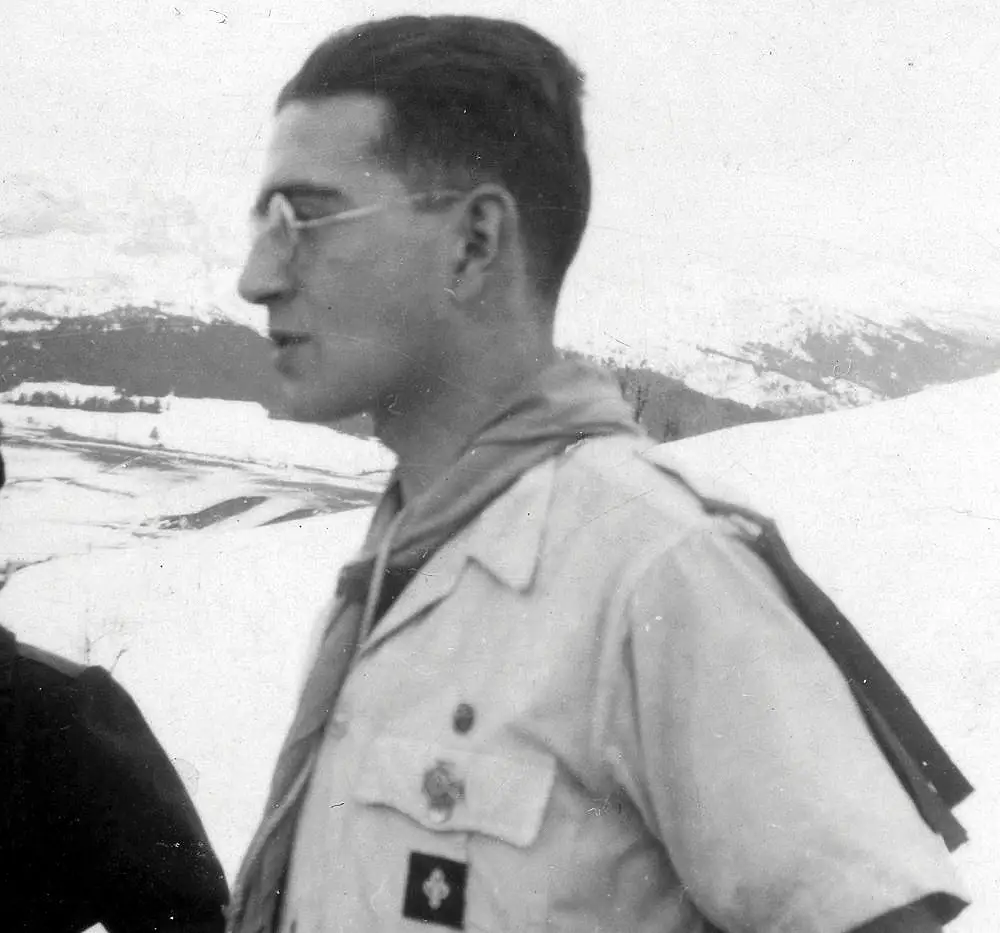
It would seem that scouting, obviously clandestine, was the most significant manifestation of patriotic activity within the high school in terms of numbers. Jan Harwas was responsible for the Polish scouts organisation, and Philippe Blanc for the French organisation. We have no information on the size of the movement, the numbers of the various groups, their forms of action, or their influence within each class. We only know that the organisation functioned better in the junior high school classes than in the high school classes.
The clandestine military aspect came under General Juliusz Kleeberg ‘s military organisation, in which it was involved. We assume that it existed at the high school from 1941 onwards. Then, from 1942, the Polish Organisation for Independence was present in Villard, which later became known as the Polish Organisation for the Struggle for Independence (POWN). The head of the cell in Villard was the teacher Józef Żmigrodzki, whose deputies were Michał Mierzwiński, Jan Budrewicz and Bolesław Skraba. Mierzwiński mimeographed leaflets and worked with Żmigrodzki on the radio transceiver.
One day, probably in 1941, General Kleeberg came to visit the school. Jan Kania, a student, introduced him by name to the members of the organisation present. In the junior high school classes, Kazimierz Dobrzęcki, following Budrewicz and Żmigrodzki ‘s instructions, led military training exercises (hiking in spring, cross-country skiing in winter) in groups of seven to nine students. In late 1942 and early 1943, when Żmigrodzki, Budrewicz and Skraba left Villard for London, the military organisation declined and its leadership was briefly taken on by Mierzwiński.
Many of the students, especially the younger ones, knew little about the clandestine activities within the school. Among the teachers, this was also the case for Marcel Malbos, who knew nothing about the scouting activities (unlike Philippe Blanc, who was very involved). However, he knew that the high school ‘s stamp was used for illegal purposes; from 1941 onwards, linoleum stamps were even made for the underground organisation’s requirements. One day in November 1940, however, he went specially to Nice, at Zaleski ‘s request, to deliver a verbal message he had learnt by heart. He has forgotten the details of the episode, except for one: the message was communicated to him by the director in the bathroom, with all the taps running!
Independently of these clandestine networks, some students hid handguns in their rooms. It is not certain that contacts existed with French resistance groups, let alone whether there were any arms deliveries between the Poles and the French. All we know is that one night in 1941, a group of students broke into the town hall, where shotguns, revolvers, etc. were being stored by decision of the Vichy authorities, and took a number of them. Władysław Wicha and Jadwiga Gostyńska, with the help of some students, hid these weapons at the high school’s farm.
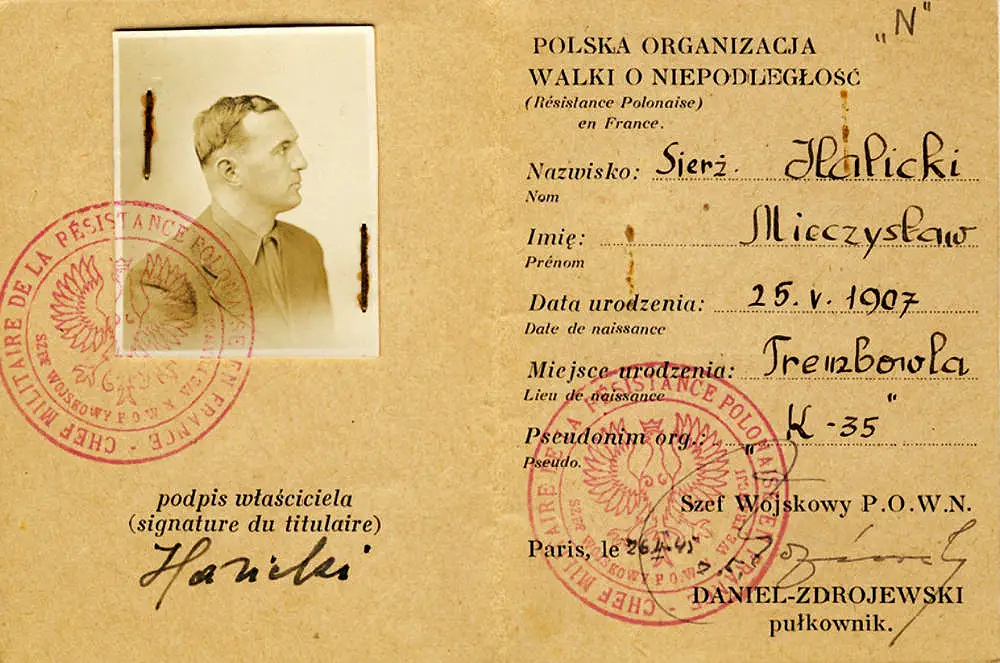
Its aim was to gather information for intelligence and propaganda purposes, but above all to organise clandestine structures among the Poles for the future fight in France. The POWN detachments, consisting of nearly fifteen thousand men, placed under the command of the French Forces of the Interior (FFI) on 29 May 1944, went into action after the Normandy landings, carrying out thousands of diversionary operations.
I had been a member of the POWN-Monika network (Polish Organisation for the Struggle for Independence) since 1 May 1942 in Lyon, where I was a student. As I had had problems with the Vichy police and my parents were in the Paris region, I was sent to Paris in 1943 and placed at the disposal of the regional network leader, Wladyslaw Kedzierski. The aim was to pass on all useful information about France, the Germans and the Poles to the Polish authorities in London; to disseminate information; to facilitate the passage of escapees of all origins and help Poles in difficulty; to obtain arms; to strengthen its own structures; and to occupy Polish premises and institutions in the capital when the time came. To varying degrees, depending on the period and the circumstances, I was required to take part in all these activities.
Before 14 July 1944, there was a normal preparation phase, as in any network, and a period of intense work. I had trouble with my pseudonym: in Lyon I was Richard, but there were already two Richards in Paris, so I quickly became Gérard.
Around 14 July, I was very tired from work and exams and asked for three days to rest. This was granted. On my return, I learned that many arrests had taken place, including that of Czesław Bitner, the head of the network, and Włodimierz Kaczorowki and Irena Lewulis, with whom I had been in contact. I received orders to leave my apartment immediately. There were only four of us left at the regional headquarters and we were overwhelmed with work. Our priorities became to pass on information, mobilise all members and obtain weapons. This last issue particularly concerned us. I contacted people who might have been able to help us. In July, I received an offer of a delivery of German weapons and ammunition. The offer seemed too good to be true. I discussed it with Richard Kedzierski, who made enquiries and concluded that there was a danger of a German provocation. The deal had been organised by a group of young Frenchmen. We learned later what happened to them: their names are on a column in the Bois de Boulogne, where they were taken and shot.
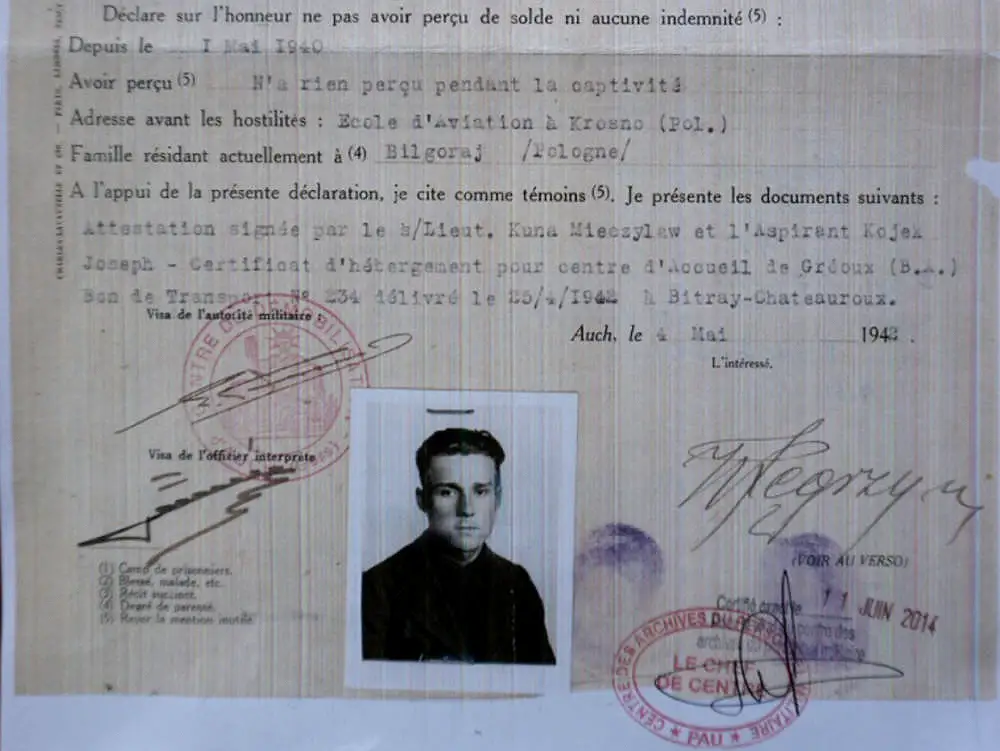
I would like to draw your attention to Józef Węgrzyn. This man did a magnificent job of helping Poles get out of occupied France and into Spain… It is hard to underestimate the services that Józef Węgrzyn rendered to the Allied cause, organising the Andorran evacuation channels through his initiatives and efforts. The measure of his talent can be summed up in one figure: the five hundred and fifty Poles, to whom must be added numerous French, Canadians, Americans and British, all safely evacuated.
One of the first evacuees, Alexander Kusnierz, was a refugee from the centre in Gréoux-les-Bains, although he spoke little Polish. However, his English was excellent, as were his references. He was suspected of working for the Gestapo, which Carlos refused to believe. Kusnierz showed enthusiasm and a spirit of sacrifice. Carlos installed him in the Hotel Palanques in La Massana, and gave him papers and an alias: Élias.
At the end of August, Élias was summoned to Barcelona for an interview and checks. Numerous Canadian, American and British pilots had gathered on the other side of the border,and were taken to Andorra by Carlos ‘s guides.
At the end of August and beginning of September 1943, Carlos went to Barcelona to escort a British pilot and three Poles, including Lieutenant Zmigrodzki, Carlos ‘s former history teacher at the Polish high school in Villard-de-Lans.
On 24 September, Carlos learned that a meeting had been held in a hotel in Les Escaldes, one of Andorra ‘s parishes, with German officers known to be part of the intelligence services, two Spaniards from Canillo and a Frenchwoman from Pamiers. It seemed fishy, and the next day Carlos set off by motorbike to San Julia, another parish in Andorra. Returning to his hotel, he asked Elias to stay there, left his room and headed for a hideout two kilometres from San Julia.
On the evening of 28 September, he was getting ready to return, but his motorbike broke down and he turned back. The next morning, he went to a garage in Andorra la Vella, but noticed a German suspected of being an informer. He headed for a garage in La Massana. On the way, he met a friend who told him that his hotel has been raided by the Gestapo, that his room has been searched and that Élias had disappeared. Carlos found that his room had indeed been ransacked. Important papers had disappeared: accounts, correspondence with Luis, encryption codes. It was serious, but not hopeless: the names of the relay towns had been exposed, but not the addresses of the hideouts and refuges.
At the same time, an evacuation organised by Élias ended in disaster: the weather was very bad, one fugitive was left dead en route, and the four other Polish fugitives, Molné (their Andorran driver) and Élias were arrested by the Gestapo on their arrival in Andorra. Only the guides manage to escape. Molné was immediately asked, “Where ‘s Carlos?”. Molné said he did not know. All the men were taken to Ax-les-Thermes and then Toulouse. After a week ‘s interrogation, Molné was released and returned to Andorra. The Poles were deported to a labour camp in Germany. We do not know Elias ‘s fate.
When things had calmed down, it was decided that the evacuations could resume, especially as Carlos ‘s guides had wasted no time, bringing seventy-seven Poles back to Andorra during his absence. Carlos and Luis recruited two new couriers: Tadeusz Rubach, alias Jean, and Jan Ziemkowski, alias Charles. They were sent to France to contact Colonel Jaklicz in Grenoble. The Pamiers route was reopened, as was the Carcassonne route. A new route, Salie-du-Sala, was created and received its first group of Poles at the beginning of November. Carlos opened a road to Puigcerda, avoiding Andorra, and the first Poles arrived at the end of November.
However, things got complicated. Carlos left his headquarters in Andorra for Barcelona. The Spanish police forced him to change hideouts several times. Carlos still travelled to Andorra every ten days.
In February 1944, Carlos was arrested by a Spanish border guard and taken to Seo de Urgel. Sais, the chief of police, was willing to release Carlos, but his superiors in Lerida might have been suspicious. He created a fake file and Carlos became Areny Rossel, a Frenchman, who could be released without raising suspicions. It was understood that he would remain in Lerida, at the disposal of the police, but with a great deal of freedom of movement. The evacuations had to continue. Carlos resumed good relations with Sais. Another Pole replaced him, pretending to be Areny Rossel in Lerida. The real Carlos continued to manage the evacuations until his arrest.