2.1.1 “The war started on 1 September 1939, I was nineteen.”
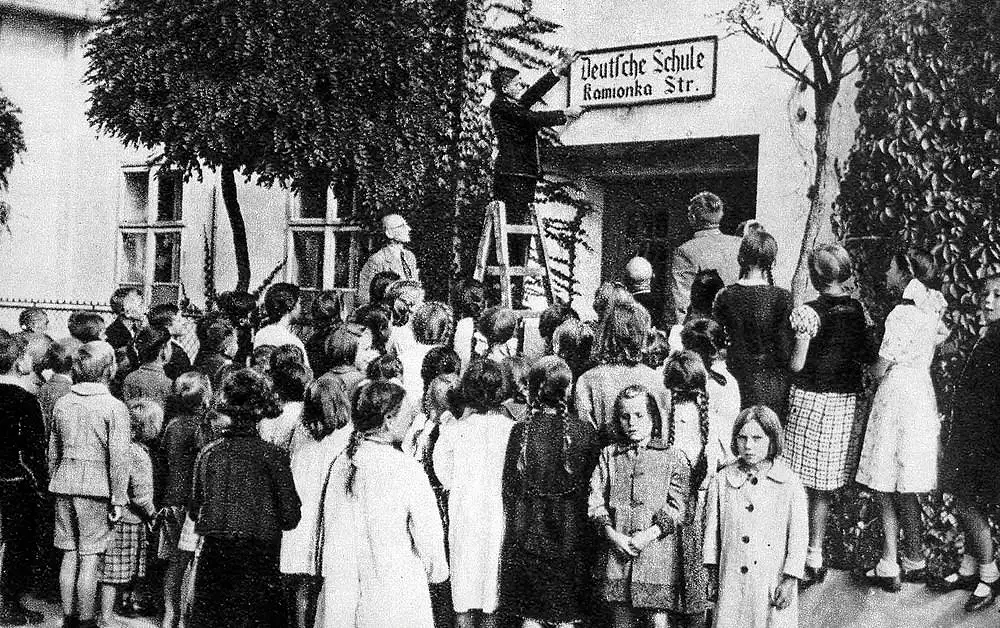
—Tadeusz Wojciechowski, student. Our school, 2017, based on Nasza Szkola, 1998.
The war started on 1 September 1939, I was nineteen and had just finished at the Stanisław Konarski vocational school in Warsaw and was working in the repair workshops of the Independent Automobile Column of the General Inspectorate of the Armed Forces, 2 Rakowiecka Street in Warsaw. As I belonged to a military institution, I could ask to be mobilised with the other workers, to bear arms and wear a uniform, and be attached to the 3rd Armoured Battalion. I managed to reach Służewiec, quite a distance away, to say goodbye to my father and those of my brothers and sisters who were at home – my mother had passed away. Then, with all my equipment, I set off with my comrades on three trailers pulled by a tractor; they were full of tyres, spare parts and essential equipment.
We spent the first night at the barracks in Modlin. We were frightened and very tense. German planes were strafing and dropping bombs one after the other on their target, which was none other than the fort where we were located.
Then, as we were marching in column through the town of Siedlce, the German planes attacked us, bombing the vehicles and machine-gunning the men as they tried to flee. Petrified, I lay on the grass in my uniform. An equally terrified young woman clutched me tightly, without even realising it.
The bombardments kept coming one after another. To protect myself from the shrapnel, I threw myself flat on some white sand, unaware of how visible my green uniform made me. A comrade who was nearby, but on the grass, thought I was dead, such was the intensity of the “hail” directed at me. Fortunately, the shots missed me.
In Kowle, trees blocked both sides of the road. When the German planes arrived, the tractor driver tried to hide under the foliage. Just then, a large branch knocked one of my comrades off the trailer. There was a muffled crack as his head was crushed under the wheels of the following trailer.
In Volhynia and Podolia, the terrain was hilly, and our tractor couldn ‘t climb with the triple load, so we had to push it up the slopes and then, once at the top, hop back on while it was moving. One of our comrades, who was tired and drowsy, tried to jump onto the high trailer, but as it was hot, his coat was open and one of the flaps got caught around the axle… he was dragged under the wheels. We were not far from the Romanian border, which we needed to reach quickly. So we had to abandon our friend in a ditch by the side of the road, slipping a piece of paper with his name into one of his pockets.
We crossed the Polish-Romanian border at Kuty. In Romania, our weapons were taken away and we were interned, first at Turnu Severin, then at Vacaresti in a long barn with two storeys of bunks fixed to the wall along its entire length. We slept side by side under blankets. This was a temporary facility. During the day, we worked for meagre pay building barracks for the internees.
In the second half of November 1939, once we had saved enough money, a comrade and I dyed our uniforms and escaped at night to the town, twelve kilometres away. There, we bought civilian coats to avoid being stopped, as soldiers were prohibited from travelling. After many adventures and a long train journey, we finally reached the Polish embassy in Bucharest. Any young Pole wishing to return to service in the Polish army was given a civilian uniform, a warm jacket and a small sum of money. After a few days in the Romanian capital, our convoy of several hundred Poles left the country almost legally.
First, we travelled up the Danube by barge, then took the train across Yugoslavia to the port city of Split. A Greek ship took us to Marseille, then we travelled across France by train to arrive in mid-December 1939 at the Polish military camp at Coëtquidan in Brittany.